
Efficacy of Paecilomyces lilacinus in the control of Meloidogyne incognita which attacks the cultivation of Capsicum annuum, “piquillo pepper”
Article Sidebar
Main Article Content
Abstract
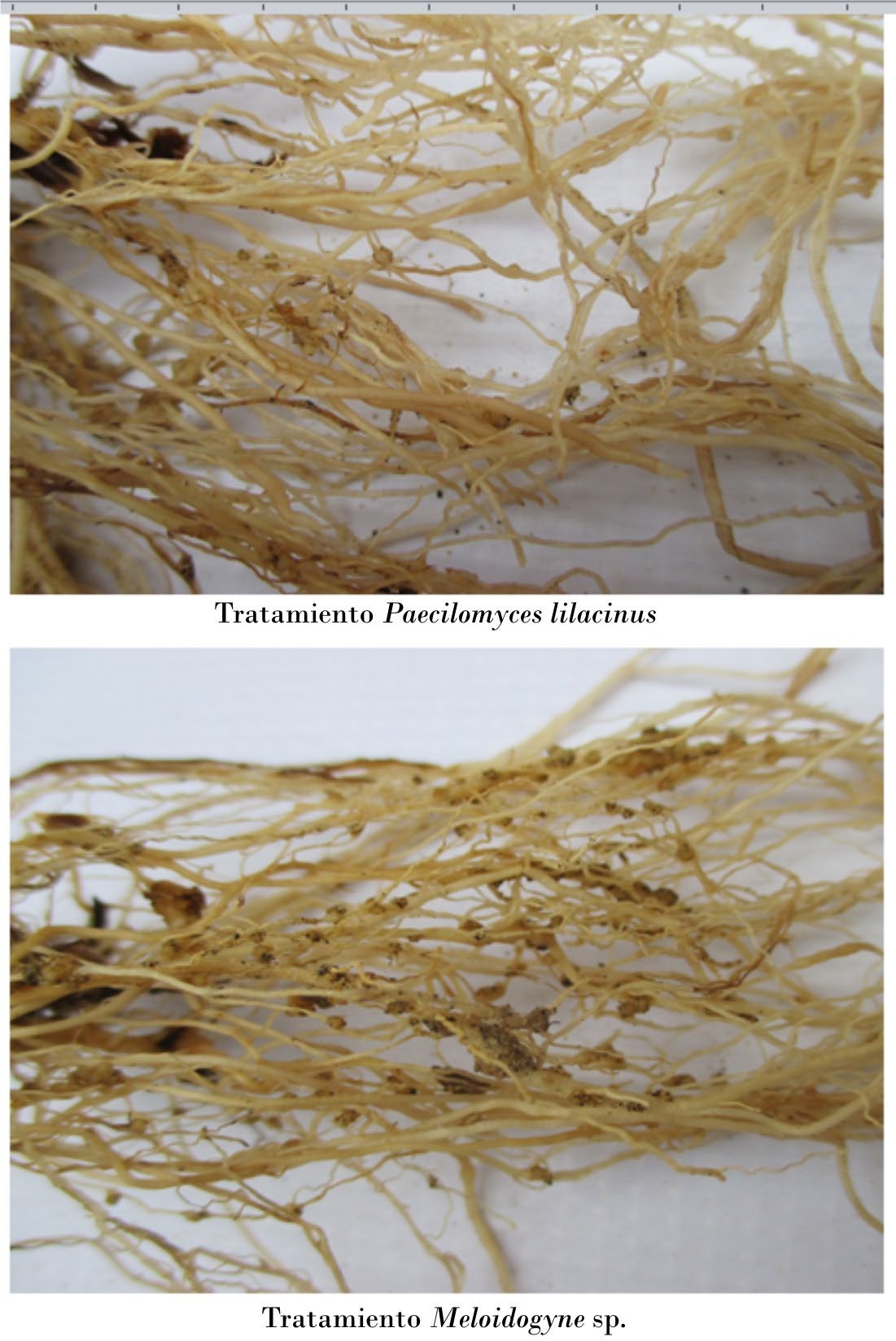
In recent years the root knot nematodes, Meloidogyne sp., have joined the phytosanitary problems that limit the production of Capsicum annuum. In contrast to “contaminant” chemical control is the alternative of biological control. Therefore, the interest to demonstrate the efficacy of Paecilomyces lilacinus on root nodulation produced by Meloidogyne incognita that parasitizes C. annuum “piquillo pepper” cultivated under greenhouse conditions. Four experimental groups and one control were performed, with 15 replicates each; humus and sand (1:1) were used as substrate, to which 10, 20, 30 and 40 kg/ha of P. lilacinus were added two weeks before transplantation according to experimental design. A seedling of pepper was planted in each 5-kg bag, and a week earlier 10,000 eggs of the phytonematode were inoculated. The plants were evaluated at ten weeks, taking into account: plant weight and length, leaf number, stem diameter, severity, efficacy, and relating them by analysis of variance, and Duncan’s test. The results show that treatments with P. lilacinus at a dose of 30 and 40 kg/ha presented the lowest levels of severity and the highest levels of efficacy. It is concluded that the biological control with P. lilacinus is an alternative as part of the integrated management of the root knot nematode.
Article Details

This work is licensed under a Creative Commons Attribution-NonCommercial 4.0 International License.
Those authors who have publications with this journal accept the following terms of the License Attribution-NonCommercial 4.0 International (CC BY-NC 4.0):
You are free to:
- Share — copy and redistribute the material in any medium or format
- Adapt — remix, transform, and build upon the material
The licensor cannot revoke these freedoms as long as you follow the license terms.
Under the following terms:
- Attribution — You must give appropriate credit, provide a link to the license, and indicate if changes were made. You may do so in any reasonable manner, but not in any way that suggests the licensor endorses you or your use.
- NonCommercial — You may not use the material for commercial purposes.
- No additional restrictions — You may not apply legal terms or technological measures that legally restrict others from doing anything the license permits.
The journal is not responsible for the opinions and concepts expressed in the works, they are the sole responsibility of the authors. The Editor, with the assistance of the Editorial Committee, reserves the right to suggest or request advisable or necessary modifications. They are accepted to publish original scientific papers, research results of interest that have not been published or sent to another journal for the same purpose.
The mention of trademarks of equipment, instruments or specific materials is for identification purposes, and there is no promotional commitment in relation to them, neither by the authors nor by the publisher.
How to Cite
References
Baermann, G.: Eine einfache Methode zur Auffindung von Ankylostomum- ( Nematoden)-Larven in Erdproben, Weltevreden Batavia, Geneesk. Lab. Feestbundel: 41-47, Germany. 1917.
Bridge, J.; P. L. Page: “Estimation of root-knot nematode infestation levels on roots using a rating chart”, Tropical Pest Management 26: 296-298, USA, 1980.
Busquets, J. O.; J. Sorribas; S. Verdejo: “Potencial reproductor del nemátodo Meloidogyne spp. en cultivos hortícolas”, Investigación Agraria. Producción y Protección Vegetal 9(3), España, 2005.
Cabanillas, E.; K. R. Barker; M. I. Daykin: “Histology of the interactions of Paecilomyces lilacinus with Meloidogyne incognita on tomato”, J. Nematol. 20: 362-265, USA, 1988.
Cardenas, D.; F. Benavides: “Efecto del hongo Paecilomyces lilacinus (Thom) Samson sobre el nemátodo de agalla Meloidogyne incognita Chitwood del melón (Cucumis melo Linn.) y la sandía (Citrollus vulgaris Schrad.) en una zona del municipio de Taminango, Nariño”. Tesis Ingeniero Agrónomo, Universidad de Nariño, Facultad de Ciencias Agrícolas, Pasto, pp. 109, México, 2006.
Christie J.; V. G. Perry: “Removing nematodes from soil”, Proceedings of the Helminthological Society of Washington, Vol. 18, no.2, pp. 106-108, USA, 1951.
Farfán, M.: “Comportamiento del nemátodo del nódulo Meloidogyne incognita (Kofoind & White, 1919) Chitwood, 1949, con 12 productos químicos” Facultad de Agronomía-Universidad Nacional Agraria La Molina, Lima, Perú, 3 pp., 2011.
Fernández B., G.: “Extracción, análisis, estabilidad y síntesis de Capsaicinoides”, Facultad de Ciencias, Universidad de Cádiz, España, 6 pp., 2007.
Gil R., A.; J. Chico-Ruiz: “Efecto del extracto de Tagetes patula L. sobre la nodulación radicular de Cucurbita maxima L. ocasionado por Meloidogyne sp., Sagasteguiana, 1(2):41-50, Perú, 2013.
Giraldo, M. A.; T. Leguizamón: “Evaluación de Paecilomyces lilacinus para el control de Meloidogyne spp. en almácigos de café var. Caturra”, Fitopatología Colombiana, 21(2): 104-117, Colombia, 1997.
Hernández-Leal, T. I.; G. Carrión; G. Heredia: “Solubilización in vitro de fosfatos por una cepa de Paecilomyces lilacinus (Thom.) Samson”, Agrociencia 45:881-892, México. 2011.
Hidalgo, A. D.: “Actividad nematicida sobre Meloidogyne hapla de extractos acuosos de especies arbóreas y arbustivas de la zona sur de Chile”. Tesis. Facultad de Ciencias Agrarias, Universidad Austral de Chile, Chile, 2008.
Linares, I.: “Control de Meloidogyne sp. en viveros de café (Coffea arabica L.) mediante el hongo Paecilomyces lilacinus”. Tesis Ing. Agr. Salvador, Salvador, Universidad de El Salvador, 67 pp., El Salvador, 2009.
Lora, D.; R. Betancourth: “Evaluación de los hongos Beauveria bassiana, Metarhizium anisopliae y Paecilomyces lilacinus. en el control de Meloidogyne spp. en Lulo Solanum quitoense y tomate de árbol Solanum betacea”, Memorias, VI Seminario Científico Internacional de Sanidad Vegetal, La Habana, Cuba, 2008.
Ministerio de Agricultura, Dirección General de Competitividad Agraria: Pimiento piquillo, Disponible en: http://minagri.gob.pe/portal/download/pdf/herramientas/organizaciones/dgca/pimiento-piquillo. pdf. Perú. 2015.
Monzón A.; I. Herrera; E. Méndez: “Uso y manejo de Paecelomyces lilacinus para el control de nematodos” Guía. Proyecto de Innovaciones Tecnológicas para el manejo ecológico de nemátodos, antracnosis y roya de café, PASA/DANIDA, Nicaragua, 2009.
Nasr E.; P. Ansari: “The effects of Paecilomyces lilacinus on the pathogenesis of Meloidogyne javanica and tomato plant growth parameters”, Agricultural Research, vol. 24, N° 2 and Vol. 25, N° 1, Irán, 2006.
Rodríguez, Y.; T. Depestre; O. Gómez: “Obtención de líneas de pimiento (Capsicum annuum) progenitoras de híbridos F1, resistentes a enfermedades virales, a partir del estudio de cuatro subpoblaciones”, Cien. Inv. Agr. 34(3): 237-242, La Habana, Cuba, 2007.
Ros-Ibáñez, C.; L. Robertson; M. Martínez-Lluch; A. Cano-García; A. Lacasa-Plasencia: “Development of virulence to Meloidogyne incognita on resistant pepper rootstocks”, Spanish Journal of Agricultural Research 12(1): 225-232, España, 2014.
Salazar G. C.; G. C. Betancourth; M. A. Castillo: “Efecto de controladores biológicos sobre el nemátodo Meloidogyne spp. en Lulo (Solanum quitoense Lam.)”, Revista de Ciencias Agrícolas 29(2): 81-92, Colombia, 2012.
Singh S. K.; M. Hodda; G. J. Ash; N. C. Banks: “Plant-parasitic nematodes as invasive species: characteristics, uncertainty and biosecurity implications”, Annals of Applied Biology, England, 2013.
Starr, I. L; R. Cook; I. Bridge: Plant Resistance to Parasitic Nematodes, CAB International, pp. 1-36, England, 2002.
Xiujuan, Y.; H. Xiujuan; Z. Liang: “Chitinasas of Paecilomyces lilacinus and studies on the biocontrol of plant parasitic nematodes”, Acta Agriculturae Universitatis Jiangxiensis 22(1):86-89, China, 2000.