
Analysis of the utilization of biological control agents in the protected crop systems in Cuba
Article Sidebar
Main Article Content
Abstract
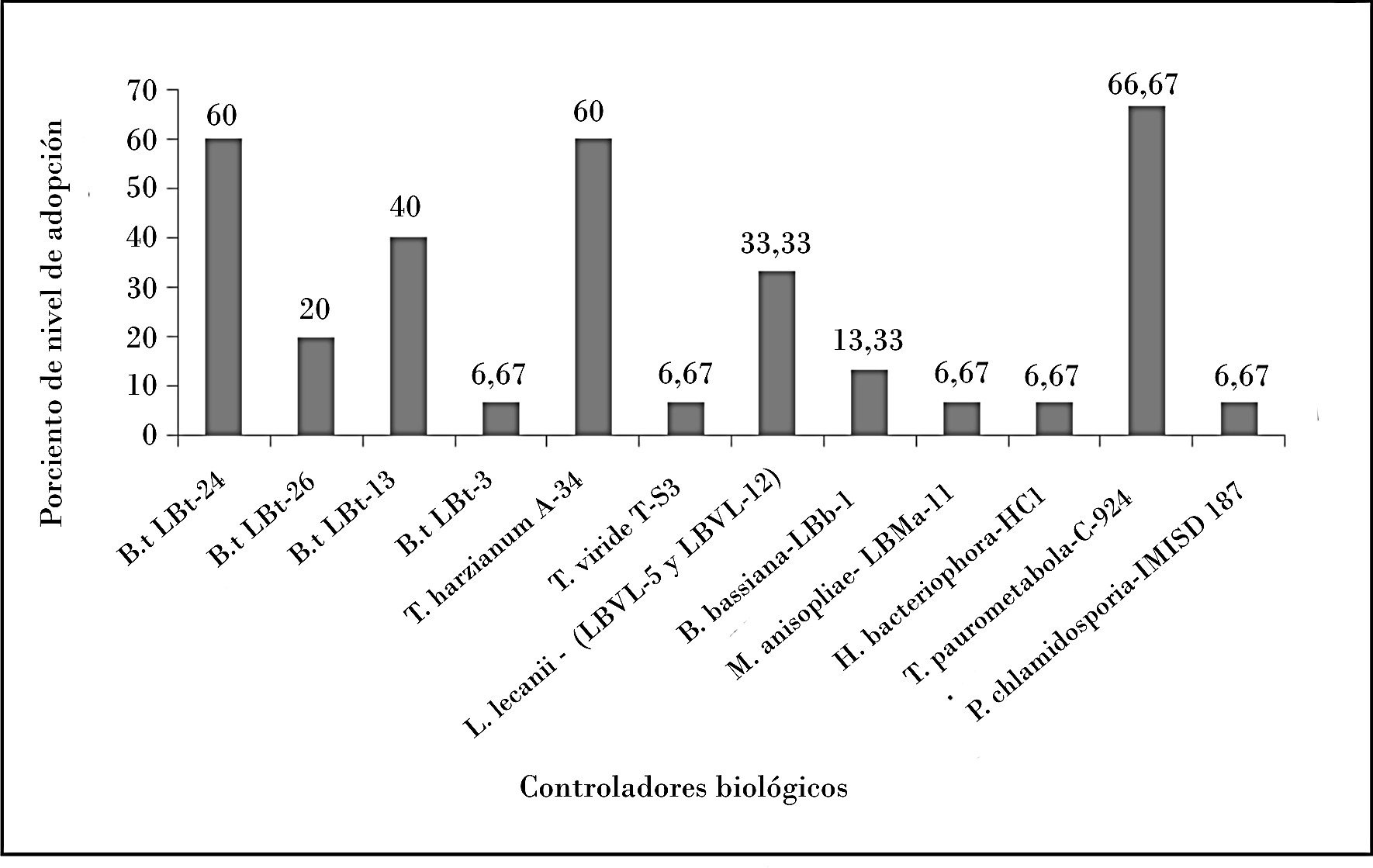
Biological control has been promoted in Cuba, since 1998 in conventional farming systems and latter in urban and periurban agriculture, however its introduction in protected cultivation technology has started in 2006 year as a component of pest management with the support of international and national projects through research and training programs. The aim of this study was to update the use of biological control agents in these protected systems. A national survey and also participative workshops were held during 2013-2014. It was determined that 13 biological controls agents are used: Bacillus thuringiensis (strains LBt-24, LBt-26, LBt-13 y LBt-3), Beauveria bassiana strain LBB-1, the nematode Heterorhabditis bacteriophora, Lecanicillium lecanii (strains LBVL-5 y LBVL-12), Metarhizium anisopliae strain LBMA-11, the nematode Pochonia chlamidosporia IMI SD 187 (KlamiC), Trichoderma harzianum strain, A-34, Trichoderma viride strain TS-3 and the bacteria Tsukamurella paurometabola strain C-924 ((Heber Nem). Of these, T. paurometabola was found to be generalized in 66.67 % while B. thuringiensis strain LBt-24 and T. harzianum strain A-34, by 60 %. In the western provinces, except Matanzas, biological means are not applied; and in the eastern provinces (Camagüey and Granma) have an acceptable level of adoption of biological resources (60-75 %). Las Tunas and Santiago de Cuba have a very good level of use with 90 %.
Article Details

This work is licensed under a Creative Commons Attribution-NonCommercial 4.0 International License.
Those authors who have publications with this journal accept the following terms of the License Attribution-NonCommercial 4.0 International (CC BY-NC 4.0):
You are free to:
- Share — copy and redistribute the material in any medium or format
- Adapt — remix, transform, and build upon the material
The licensor cannot revoke these freedoms as long as you follow the license terms.
Under the following terms:
- Attribution — You must give appropriate credit, provide a link to the license, and indicate if changes were made. You may do so in any reasonable manner, but not in any way that suggests the licensor endorses you or your use.
- NonCommercial — You may not use the material for commercial purposes.
- No additional restrictions — You may not apply legal terms or technological measures that legally restrict others from doing anything the license permits.
The journal is not responsible for the opinions and concepts expressed in the works, they are the sole responsibility of the authors. The Editor, with the assistance of the Editorial Committee, reserves the right to suggest or request advisable or necessary modifications. They are accepted to publish original scientific papers, research results of interest that have not been published or sent to another journal for the same purpose.
The mention of trademarks of equipment, instruments or specific materials is for identification purposes, and there is no promotional commitment in relation to them, neither by the authors nor by the publisher.
How to Cite
References
Almándoz, J.; E. Fernández; G. González: “Informe de avance del Proyecto Perfeccionamiento de Manejo de Plagas en Cultivos Protegidos, en los cultivos de tomate, pimiento, pepino y melón. Actualización y evaluación de adopción del Manejo de Plagas en cultivos protegidos”, Código: P131LH0030017. Programa Salud Animal y Vegetal. Diciembre, INISAV, Cuba, 2014.
Almaguel, L.; P. E. De la Torre: Manual de acarología agrícola, Instituto de Investigaciones de Sanidad Vegetal, Cuba, 2014.
Anzardo, J. C.: “Los cultivos protegidos en Cuba”, VIII Encuentro Nacional de Cultivos Protegidos, abril, Cuba, 2016.
Díaz, Y.: “Informe anual del Proyecto Perfeccionamiento del Manejo de Plagas en los cultivos: tomate, pimiento, pepino y melón en la tecnología de cultivos protegidos”, Cod: P131LH0030017. Programa Salud Animal y Vegetal, INISAV, Cuba, 2014.
Farrera, R.: “Acerca de los plaguicidas y su uso en la agricultura”, Revista Digital del Centro Nacional de Investigaciones Agropecuarias de Venezuela, 2013, CENIAP HOY, no. 6, septiembre-diciembre 2004. Maracay, Aragua, Venezuela. Disponible en: www.ceniap.gov.ve/ceniaphoy/articulos/n6/arti/farrera_r/arti/farrerar.htm. Consultado el 20 de enero de 2013.
FAO: “Código Internacional de Conducta para la Distribución y Utilización de Plaguicidas. Directrices sobre la prevención y Manejo de la Resistencia a los Plaguicidas”, septiembre 12. Consultado 20/7/2015, http://www.fao.org/fileadmin/templates/agphome/documents/Pests_Pesticides/Code/FAO_RMG_SP.pdf. Consultado 20 de julio de 2015.
Fuentes, P. F.; E. Concepción; M. E. Cristo: “Evaluación de nematicidas biológicos en el control del nemátodo agallero (Meloidogyne incognita Chitwood) en el cultivo protegido del tomate (Lycopersicon esculentum Mill.)”, Infociencia (15) 2:1-11, Cuba, 2011.
Grande, L.; J. M. Q. Luz; B. De Melo; R. M. Q. Lana; J. M. O. Carvalho: O cultivo protegido de hortaliças em Uberlândia-MG. Horticultura Brasileira 21(2) 241-244, Brasilia, Brasil,2013.
Gómez, L.; M. G. Rodríguez; R. Enrique; I. Miranda; E. González: “Especies de Meloidogyne asociadas a la producción protegida de hortalizas y potencialidades de prácticas agronómicas para su manejo”, Fitosanidad. 2(4): 250-251, Cuba, 2008.
Goto, R.: “Plasticultura nos trópicos: uma avaliação técnico-econômica”, Horticultura Brasileira 15: 163-165, Brasilia, Brasil, 1997.
Hidalgo, H.: “Investigación, desarrollo e innovación de Pochonia chlamydosporia var. catenulata como agente microbiano para el control de nemátodos formadores de agallas”, Protección Vegetal (28) 3: 238, Cuba, 2013.
Márquez, M. E.: “Selección y evaluación tóxico-patogénica de cepas cubanas de Bacillus thurigiensis con actividad nematicida”, tesis en opción al grado de Doctor en Ciencias Agrícolas, La Habana, 2005.
Mena, J.; E. Pimentel; A. T. Hernández; L. León; Y. Ramírez; I. Wong; M. Marin; J. D. Mencho; M. Hernández; A. Del Castillo; I. Sánchez; M. Expósito; G. Jiménez; M. Flietas; G. García; N. González; J. Zamora, E. Zalazar, V. Olivera, G. Rodríguez, B. Álvarez, H. Dandie, M. del C. Sánchez; R. Pimentel; C. Pérez; O. Compte; M. Sardiñas; L. Martínez; A. Moreira; D. Salinas; C. García; R. Basalto; C. Borroto; L. Herrera: “El uso del bionematicida Heber Nem en los cultivos protegidos”, Fitosanidad (10) 2, Cuba, 2006.
Méndez, M. A.; G. Polanco: “Método de control de nemátodos con Trichoderma harzianum en casas de cultivo”, Fitosanidad (10) 2, Cuba, 2006.
Ministerio de la Agricultura. Centro Nacional de Sanidad Vegetal. 2014. Programa de Defensa de Sistemas de Cultivo Protegido, 2 p., Cuba.
Ministerio de la Agricultura. Centro Nacional de Sanidad Vegetal: “Análisis del cumplimiento del programa de producción de medios biológicos en el año 2015”, 2015.
Moreno, D.; E. Botta; B. L. Muiño; A. C. Porras: “Diagnóstico fitosanitario y tecnológico de los cultivos protegidos en Cuba”, Fitosanidad vol. 12, no. 1:15-19, Cuba, 2008.
Muiño, B.; E. Botta; E. Pérez; A. Ballester; D. Moreno; F. Rodríguez; E. Fernández; R. Cuadra: “Sistemas de Manejo Integrado de Plagas como alternativa al uso de bromuro de metilo en la producción de cultivos protegidos, flores y ornamentales en Cuba”, INISAV, Boletín fitosanitario 12 (1), Cuba, 2007.
Ozcatalbas, O. B.; C. Sayin: “Analysis of Extension Services and Growers’Knowledge Level in Greenhouse Production in Antalya, Turkey, Journal of Agricultural Research, Tanta University, Special Issue 28(3):990-998, Turquía, 2002.
Pérez, A.; V. A. Fernández; D. Francisco López; J. J. A. Tores: “Resistencia a inhibidores de la biosíntesis de ergosterol y a estrobilurinas en oídio de cucurbitáceas”, Phytoma de España, no. 173:19-24, 2005.
Pérez, G.: “Alternativas biológicas de lucha contra nemátodos noduladores en tomate (Lycopersicon sculentum Mill.) bajo casas de cultivos protegidos”, VII Jornada Científico Técnica de Sanidad Vegetal en Cienfuegos, 21 y 22 de junio de 2016.
Puertas, A.: “Uso de Pochonia chlamydosporia var. catenulata (Kamyscho ex Barron y Onions) Zare y Gams como agente de control biológico de Meloidogyne incognita (Kofoid y White) Chitwood en cultivos hortícolas”, tesis en opción al grado de Doctor en Ciencias Agrícolas, UNAH-CENSA, Cuba, 2007.
Puerto, A. M.; S. Suárez; D. E. Palacio: “Efectos de los plaguicidas sobre el ambiente y la salud”, Higiene y Epidemiología vol. 52, 3:372-387, La Habana sept.-dic., Cuba, 2014.
Quiala, R. de los A.; E. Isaac; F. A. Simón; I. Regueiferos; G. Montero: “Efecto del agua tratada con campo magnético estático sobre Meloidogyne spp. en Cucumis sativus en condiciones de cultivo protegido”,Centro Agrícola, 38(4): 83-87, Cuba, 2011.
Rodríguez, F.: “Informe final del Proyecto: Manejo Integrado de Plagas y enfermedades en cultivos protegidos”, Código: 801005, INISAV, Cuba, 2005.
Trujillo, G. Z.; R. P. Pérez; D. Borroto; E. Concepción: “Efectividad de hongos entomopatógenos y Bacillus thuringiensis sobre Thrips palmi Karny en el cultivo del pepino”, Fitosanidad 7(4):13-18, Cuba, 2003.
Vázquez, L. L.; S. Caballero; A. Carr; J. Gil; J. L. Armas; A. Rodríguez; M. Becerra; L. A. Rodríguez; R. Granda; T. Corona; M. Fumero; M. Peña; I. Essen; L. Leyva; E. Concepción; T. Ramos; O. Corbea: “Diagnóstico de la utilización de entomófagos y entomopatógenos para el control biológico de insectos por los agricultores en Cuba”, Fitosanidad 14 (3): 159-169, Cuba, 2010a.
Vázquez, L. L.; J. M. Álvarez: Control ecológico de poblaciones de plagas, Instituto de Investigaciones de Sanidad Vegetal. Ministerio de la Agricultura, La Habana, Cuba, 2011.
Vázquez, L. L.; C. Murguido; A. Navarro; M. García: “Resultados de un proceso de capacitación e innovación participativas para la adopción del manejo agroecológico de la broca del café en Cuba”, Agroecología 5: 53-62, Cuba, 2010b.