
Distribution of Tomato chlorotic spot virus (TCSV) in tomato crops of tomato (Solanum lycopersicum L.) in Cuba
Article Sidebar
Main Article Content
Abstract
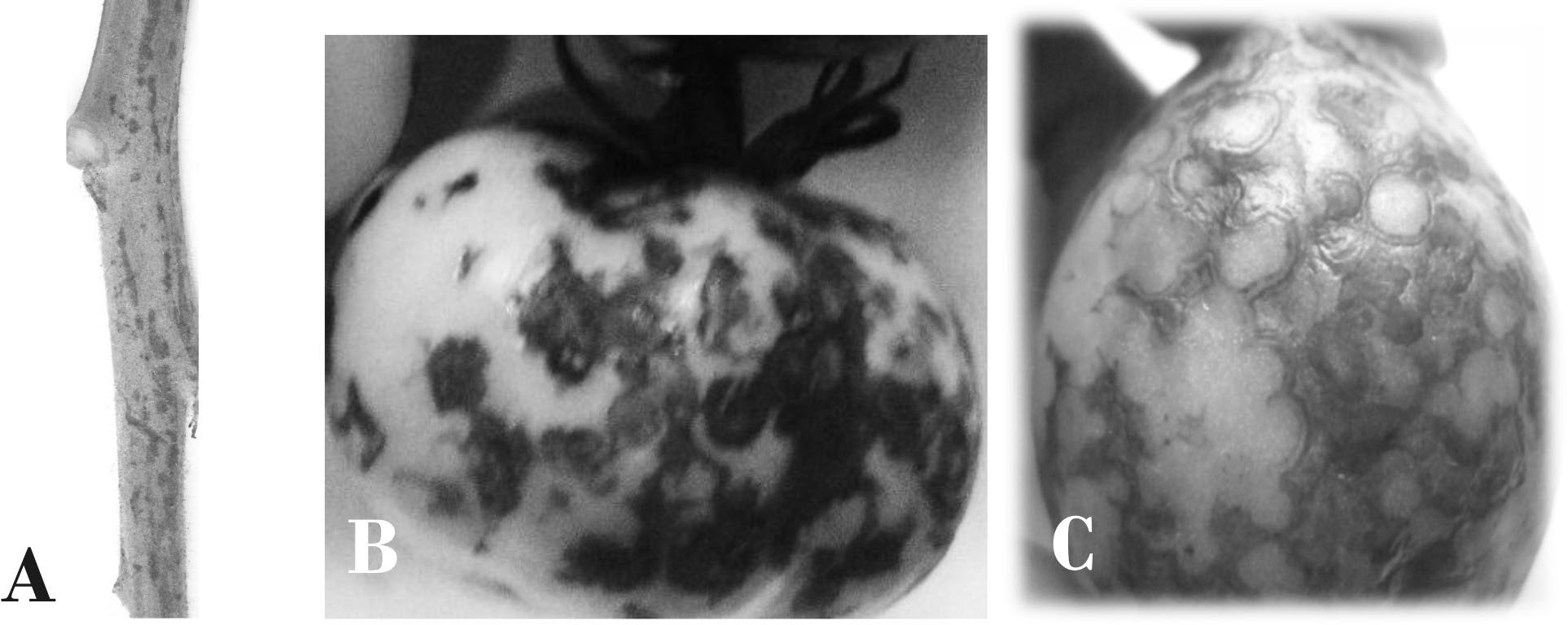
In Cuba, since 2009, symptoms on tomato plants (Solanum lycopersicum L.), similar to those caused by the genus Tospovirus, were observed. However, since the 2012-2013 campaign, there was a considerable increase on symptoms intensity, in some crop areas of Artemisa, Mayabeque and Guantanamo provinces; and the presence of Tomato chlorotic spot virus (TCSV), belonging to the genus Tospovirus, was determined by molecular techniques. The aim of this study was to determine the presence of this virus as well as the symptoms it cause, in tomato growing areas of the remaining provinces. For this purpose, areas of different municipalities of the western, central, eastern provinces, and protected cultivation houses were sampled. The samples was mechanically inoculated in tomato var. Rilia and in indicator plants Nicotiana glutinosa L., Nicotiana tabacum L. var. White Burley, var. Criollo 98 and Chenopodium quinoa Wild. To confirm the presence of Tospovirus, and species, samples showing symptoms were analyzed by RT- PCR Hypersensitivity reactions were detected on indicator plants. The genus Tospovirus and species TCSV were detected in all sampled locations, except for some samples from Guantanamo province, with which the segment was not found with the expected hope for the pair of primers in RT-PCR. In tomato, it was observed, in general, leaves displaying chlorotic and necrotic spots, bronzed coloration, and fruits with very pronounced necrotic spots and rings.
Article Details

This work is licensed under a Creative Commons Attribution-NonCommercial 4.0 International License.
Those authors who have publications with this journal accept the following terms of the License Attribution-NonCommercial 4.0 International (CC BY-NC 4.0):
You are free to:
- Share — copy and redistribute the material in any medium or format
- Adapt — remix, transform, and build upon the material
The licensor cannot revoke these freedoms as long as you follow the license terms.
Under the following terms:
- Attribution — You must give appropriate credit, provide a link to the license, and indicate if changes were made. You may do so in any reasonable manner, but not in any way that suggests the licensor endorses you or your use.
- NonCommercial — You may not use the material for commercial purposes.
- No additional restrictions — You may not apply legal terms or technological measures that legally restrict others from doing anything the license permits.
The journal is not responsible for the opinions and concepts expressed in the works, they are the sole responsibility of the authors. The Editor, with the assistance of the Editorial Committee, reserves the right to suggest or request advisable or necessary modifications. They are accepted to publish original scientific papers, research results of interest that have not been published or sent to another journal for the same purpose.
The mention of trademarks of equipment, instruments or specific materials is for identification purposes, and there is no promotional commitment in relation to them, neither by the authors nor by the publisher.
How to Cite
References
Batuman, O.; M. R. Rojas: “First Report of Tomato chlorotic spot virus in Processing Tomatoes in the Dominican Republic”, Plant Disease, vol. 98, Number 2 Page 286, EE.UU., February, 2014.
Baysal-Gurel, F.; R. Li; K.-S. Ling: “First Report of Tomato chlorotic spot virus Infecting Tomatoes in Ohio”, Plant Disease, vol. 99, Number 1, Page 163, January 2015.
De Ávila A.; C. P. de Haan; M. L. L. Smeets; R. de O. Resende; R. Kormelink; E. W. Kitajima; R. W. Goldbach; D. Peters: “Distinct Levels of Relationships Between Tospovirus Isolates”, Archive of Virology 128 (3-4):211-227, 1993.
Fiallo-Olive E.; Y. Martínez-Zubiaur; R. F. Rivera-Bustamante: “Tomato yellow leaf distortion virus, new bipartite begomovirus infecting tomato in Cuba”, Plant Pathology 58(4):785, 2009.
González Arias, G.; A. L. Echemendía Gómez; C. Font Díaz; I. Quiala Rodríguez; E. Javer Higginson; M. del Loreto Reyes Garriga; N. Arencibia Gámez; A. Fonseca Arias; A. Pérez Pezcosa; M. Cruz Martín; C. Nápoles Albanes: “Información primaria de la presencia del género Tospovirus en Cuba”, Fitosanidad vol. 14, no. 4, 2010.
Hanssen, I. M.; B. Thomma Lapidot: “Emerging Viral Deseases of Tomato Crops”, Current Review 23 (5): 539-548, 2010.
Londoño, A.; H. Capobianco; S. Zhang; J. E. Polston: First Record of Tomato Chlorotic Spot Virus in the U.S., Tropical Plant Pathology 37: 333-338, 2012.
Martínez-Zubiaur, Y.; I. Zabalgogeazcoa; C. de Blas; F. Sánchez; E. L. Peralta; J. Romero; F. Ponz: “Geminivirus Associated with Diseased Tomatoes in Cuba”, J. Phytophatology 144, 277-279, 1996.
Martínez-Zubiaur, Y.; C de Blas; I. Zabalgogeazcoa; M. Quiñones; C. Castellanos; E. L. Peralta; J. Romero: “Habana tomato virus, a new bipartite geminviruses”, Archive of Virology, 143:1757-1772, 1998.
Martínez-Zubiaur, Y. L.; H. Chang Sidorchuk; N. González Álvarez; Barbosa Vargas; G. González Arias: “First molecular evidence of Tomato chlorotic spot virus (TCSV) infecting tomatoes in Cuba”, Plant Disease Note PDIS-01-16-0082-PDN. R1, Febrero 2016.
Mumford, R A.; I. Barker; K. R. Wood: “An improved method for detection of Tospovirus using the polymerase chain reaction”, Journal of Virological Methods, 57, 109-115, 1996.
Norris, D. O.: “The strain complex of and Symptom development of spotted wilt virus”, Bulletin of the Australian Council of Science and Industrial Research no. 202, 1946.
ONEI, Oficina Nacional de Estadística e Información: Panorama Económico y Social de Cuba, Editora Abril, 2014, edición digital, en sitio: www.onei.cu.
Polston, J. E.; A. Londoño: “A New Virus for Florida Tomatoes”, In Proc. of the Florida Tomato Institute, edited by M. Ozores-Hampton and C. Snodgrass, 27-29. Naples, Fl., Florida Tomato Institute, 2012.
Ramos, P. L.; O. Guerra; R. Peral; P. Oramas; R. G. Guevara; R. Rivera-Bustamante: “Taino tomato mottle virus, a new bipartita Geminivirus from Cuba”, Plant Disease 1095, E., 1997.
Resende, R. De O.: “Generation and characterization of mutants of tomato spotted wilt virus”, Ph.D. Thesis. Wageningen Agricultural University, Wageningen, Netherlands, 1993.
Rodríguez-Romero, A.; P. Posos Ponce; Y. Castillo Duvergel; M. Suris Campos: “Especies de los géneros Thrips y Frankliniella (Thysanoptera: Thripidae) asociadas a cultivos de en la provincia de Guantánamo”, Protección Vegetal, vol. 26, no. 3, 144-148, 2011.
Webster; C. G.; K. L. Perry; X. Lou: L. Horsman; G. Frant; C. Mellinger; S. Adkins: “First report of Groundnut ringspot virus infecting tomato in south Florida”, Plant Health Progress doi: 10.1094/PHP-2010-0707-01-BR. 2010.
Webster, C. G.; W. Turechek; W. Mellinger; H. Frantz; G. Roe; N. Yonce; H. Vallad; S. Adkins: “Expansion of Groundnut ringspot virus host and geographic ranges in solanaceous vegetables in peninsular Florida. Online”, Plant Health Progress doi: 10.1094/PHP-2011-0725-01-BR. 2011.
Webster C. G.; G. Frantz; R. Stuart; E. Joseph; C. Mellinger; E. McAvoy; W. Turechek; S. Marshall; Y. Tantiwanich; M. McGrath; M. Daughtrey; S. Adkins: “Emergence of Groundnut ringspot virus and Tomato chlorotic spot virus in Vegetables in Florida and the Southeastern United States”, Phytopathology, vol. 105, Number 3, 388-398, Mar 2015.