
Basal rot in adult plants of capped tobacco caused by Pythium aphanidermatum
Article Sidebar
Main Article Content
Abstract
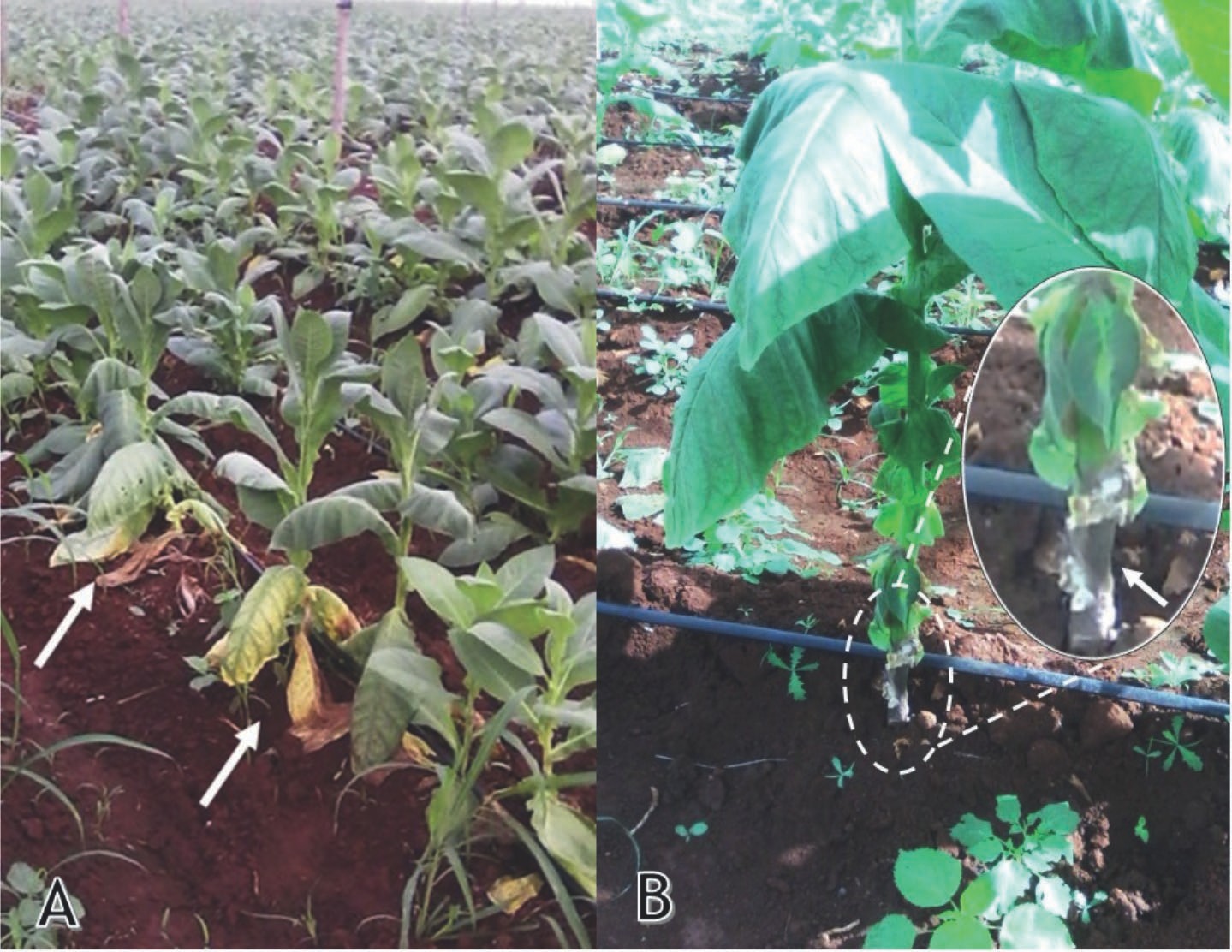
During the tobacco campaign of 2016, were detected adult plants of cv. Criollo 98 with wet dark brown lesions from roots to the stems base at soil level. Affected plants also showed an accelerated foliar wilt which caused its death few days after first symptoms occurred. In order to identify the causal agent of this symptomatology, roots and stem samples were taken and analyzed by the methods of blotter test and sowing in Petri´s plates containing PDA supplemented with streptomycin sulphate. Obtained isolates were characterized and pathogenicity tests were conducted to fulfill Koch´s postulates. Morpho-cultural characteristics allowed to identified the presence Pythium aphanidermatum in all of the samples analyzed. In vivo tests showed that from 10 dpi inoculated plants developed symptoms similar to those detected in the field. In none of the analyzed samples was possible to isolate P. nicotianae. In Cuba, P. aphanidermatum is reported as one of the pathogens commonly associated with Damping off in seedbeds of tobacco. However, reports related with its incidence in fields affecting adult plants were not found.
Article Details

This work is licensed under a Creative Commons Attribution-NonCommercial 4.0 International License.
Those authors who have publications with this journal accept the following terms of the License Attribution-NonCommercial 4.0 International (CC BY-NC 4.0):
You are free to:
- Share — copy and redistribute the material in any medium or format
- Adapt — remix, transform, and build upon the material
The licensor cannot revoke these freedoms as long as you follow the license terms.
Under the following terms:
- Attribution — You must give appropriate credit, provide a link to the license, and indicate if changes were made. You may do so in any reasonable manner, but not in any way that suggests the licensor endorses you or your use.
- NonCommercial — You may not use the material for commercial purposes.
- No additional restrictions — You may not apply legal terms or technological measures that legally restrict others from doing anything the license permits.
The journal is not responsible for the opinions and concepts expressed in the works, they are the sole responsibility of the authors. The Editor, with the assistance of the Editorial Committee, reserves the right to suggest or request advisable or necessary modifications. They are accepted to publish original scientific papers, research results of interest that have not been published or sent to another journal for the same purpose.
The mention of trademarks of equipment, instruments or specific materials is for identification purposes, and there is no promotional commitment in relation to them, neither by the authors nor by the publisher.
How to Cite
References
Anderson, M. G., Fortnum, B. A. y Martin, S. B., 1997. First report of Pythium myriorylum in tobacco float system in South Carolina. Plant Disease. 81, 227.
Antonopoulos, D. F. y Mila, A. L., 2011. Susceptibility of stem and root tissues of tobacco cultivars carrying or not the Ph gene to Pythium stem rot, caused by Pythium aphanidermatum. Crop Protection. 30,379-383.
Arnold, G.R.W., 1986. Lista de Hongos Fitopatógenos de Cuba. Ministerio de Cultura: Editorial Científico-Técnica, 207 p.
Bian, C., Zhao, S., Jang, K. y Kang, Y., 2016. First report of Pythium recalcitrans infecting flue-cured tobacco. Australasian Plant Disease Notes. 11,7.
Cartwright, D. K., Spurr, H. W., Jr. y Shew, H. D., 1995. Commercial potting medium as the source of Pythium causing a disease on tobacco transplants. Plant Disease. 79, 538.
Corrêa, A.S., Rocha, A.B., Willani, S.A., Dariva, J.M., Souza, M.V. y Moraes, M.G., 2011. Yellow stunt, a tobacco disease caused by Pythium dissotocum, in Southern parts of Brazil. Plant Disease. 95, 354.
Dick, M.W., 1990. Keys to Pythium. UK: University of reading press, School of Plant Science, department of botany, 64 p.
Domínguez, Y., Peréz-Álvarez, S., Magallanes-Tapia, M.A., Chá- vez-Medina, J.A., Héctor-Ardisana, E.F., 2018. Analysis of genetic polymorphism in wild Nicotiana species and Cuban cultivated tobacco (Solanaceae) through AFLP. Biotecnol Apl. 35, 2201-2205.
Erwin, D.C. y Riberiro, O.K., 1996. Phytophthora diseases worldwide. St paul, Minnesota, USA: APS Press, 562 p.
Farr, D.F. y Rossman, A.Y., 2018. Fungal Databases. Systematic Mycology and Microbiology Laboratory, ARS, USDA. http://nt.ars-grin.gov/fungaldatabases/index.cfm. (enero, 2018).
Fernández, A., Martínez, M. L., Ariosa, M. D. y Toledo, V., 2012. Detección y Prácticas de Manejo de la enfermedad Pata Prieta causada por Phytophthora nicotianae en el cultivo del Tabaco. Agroecología. 7, 73-80.
Fernández, A., Fernández, R. R., Rivera, C. A. y Calero, S., 2016. Desafíos en la gestión de las cooperativas de producción agropecuaria tabacaleras de la provincia Pinar del Río, Cuba. Agroalimentaria. 22,119-132
García, M. y Villalón, A., 2006. El cultivo sin suelo en la producción de plántulas de tabaco. Cuba Tabaco. 7, 47-51.
Gayed, S. K., 1979. The effect of steam sterilization on three pathogenic fungi in tobacco seed beds in the greenhouse. Lighter. 49, 14-15
Grijalba, P. E., Zapata, R.L., Palmucci, H. E. y Baron, C., 2015. Podre- dumbre basal de plantas adultas de tomate causada por Pythium aphanidermatum (Oomycota). Boletin de la Sociedad Argentina de Botánica. 50, 11-15.
Gutiérrez, W., Melton, T. y Mila, A., 2012. Pythium root rot in flue-cured tobacco seedlings produced in greenhouses: Factors associated with its occurrence and chemical control. Online Plant Health Progress doi:10.1094/PHP-2012-0925-01-RS.
Khan, M. R. y Haque, Z., 2013. Morphological and biochemical responses of five tobacco cultivars to simultaneous infection with Pythium aphanidermatum and Meloidogyne incognita. Phytopathologia Mediterranea. 52, 98−109.
Liu, C. F., 1976. The species and distribution of Pythium aphanidermatum and Pythium myriotylum causing damping-off of tobacco seedlings in Taiwan. Chung Hua Chih-Wu Pao Hu Husueh Hui Plant Prot. Bull.18,199-206.
Miao, P., Wang, H.T., Li, S.J. y Kang, Y.B., 2014. First report of two pathogenic fungi on tobacco in Henan Province. Chinese Tobacco Science. 2, 113-116.
Mila, M., 2010. Pythium stem rot of tobacco–Field. Plant Disease Fact Sheets. North Caroline State University, EE.UU. https://projects.ncsu. edu/cals/plantpath/extension/clinic/fact_sheets/index.php?do=disea- seyid=16. (febrero, 2016).
MycoBank, 2018. MycoBank Database, Fungal database, nomenclature y species Banks. Disponible en: http://www.mycobank.org (enero, 2018).
Mufunda, F., Muzhinji, N., Sigobodhla, T., Marunda, M., Chinheya, C. C. y Dimbi, S., 2017. Characterization of Pythium spp. associated with root rot of tobacco seedlings produced using the float tray system in Zimbabwe. Journal of Phytopathology. 165, 737-745.
Food and Agriculture Organization of the United Nations (FAO), 2019. FAOSTAT database. Disponible en: http://www.fao.org/faostat/en/#-data/QC (Marzo 2019).
Shah, H. M., Patel, D. J., Makadia, B. M. y Patel, R. C., 1984. Efficacy of certain fungicides in control of damping-off disease in Bidi Tobacco Nursery caused by Pythium aphanidermatum. Indian J. Mycol. Plant Pathol. 12, 339-341.
Sigobodhla, T. E., Dimbi, S. y Masuka, A. J., 2010. First Report of Pythium myriotylum Causing Root and Stem Rot on Tobacco in Zimbabwe. Plant Disease, 94, 1067.
Wong, W., Llanos, Y. y Fernández, A., 1999. Potencial infeccioso del suelo: parámetros óptimos para el desarrollo de Pythium aphanidermatum. Fitosanidad. 3.49-52.