
First report of the presence of Scirtothrips dorsalis Hood (Thysanoptera: Thripidae) in Cuba
Article Sidebar
Main Article Content
Abstract
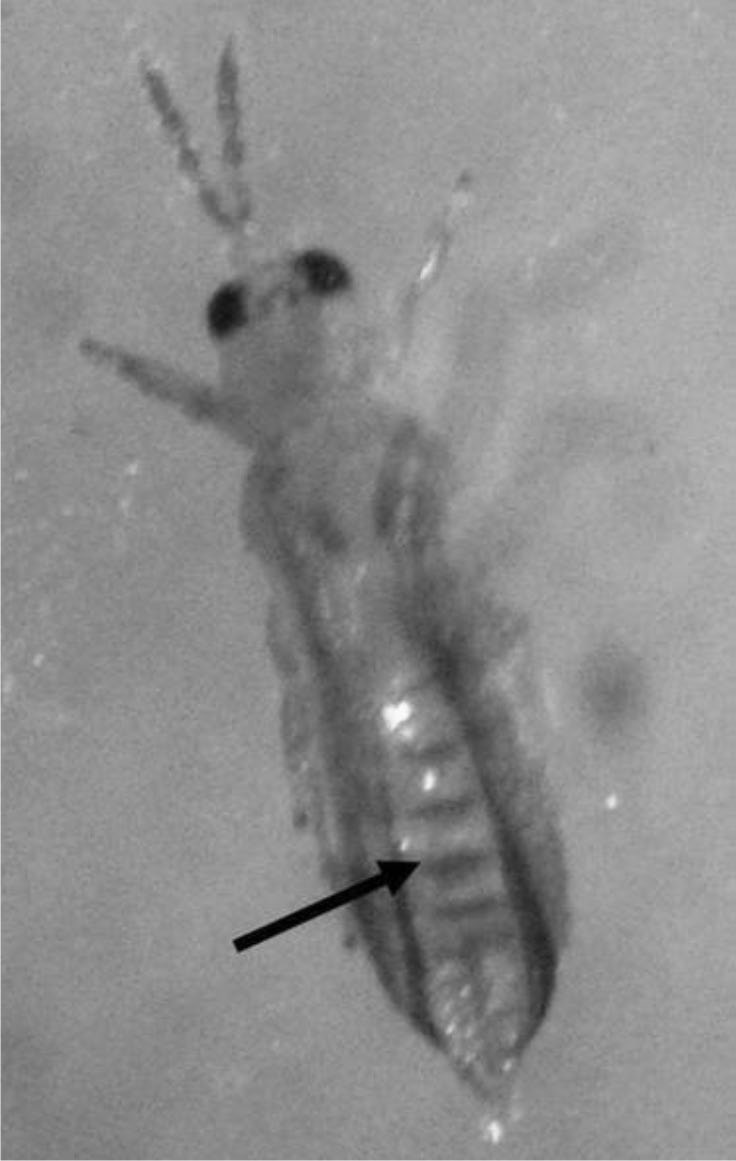
In Cuba the Thripidae family is of great importance because it groups polyphagous species that cause direct and indirect damage to crops. Within this family is located the genus Scirtothrips which is characterized by feeding on young shoots, causes atrophy of plants and some species are vectors of viruses in crops of economic interest. To determine the causal agent of the damages observed in citrus plants in the diagnostic greenhouse and Rosa spp. In the gardens of the Tropical Fruit Research Institute, symptomatic samples of young shoots were collected. The collected adult individuals were preserved in 75 % alcohol and later assembled according to the methodology of Kumar et al. (2011) for taxonomic study For the identification of the specimens, the descriptions and illustrations of Hoddel & Mound (2003), Skarlinsky (2004) and Kumar et al. (2010, 2011) were compared. The presence of nymphs and adults of a species of thrips of pale yellow color with wings of dark coloration was observed. The results of the observations of the species studied show that the characters described correspond to an adult Scirtothrips dorsalis Hood.
Article Details

This work is licensed under a Creative Commons Attribution-NonCommercial 4.0 International License.
Those authors who have publications with this journal accept the following terms of the License Attribution-NonCommercial 4.0 International (CC BY-NC 4.0):
You are free to:
- Share — copy and redistribute the material in any medium or format
- Adapt — remix, transform, and build upon the material
The licensor cannot revoke these freedoms as long as you follow the license terms.
Under the following terms:
- Attribution — You must give appropriate credit, provide a link to the license, and indicate if changes were made. You may do so in any reasonable manner, but not in any way that suggests the licensor endorses you or your use.
- NonCommercial — You may not use the material for commercial purposes.
- No additional restrictions — You may not apply legal terms or technological measures that legally restrict others from doing anything the license permits.
The journal is not responsible for the opinions and concepts expressed in the works, they are the sole responsibility of the authors. The Editor, with the assistance of the Editorial Committee, reserves the right to suggest or request advisable or necessary modifications. They are accepted to publish original scientific papers, research results of interest that have not been published or sent to another journal for the same purpose.
The mention of trademarks of equipment, instruments or specific materials is for identification purposes, and there is no promotional commitment in relation to them, neither by the authors nor by the publisher.
How to Cite
References
Boletín Epidemiológico 2012: “Situación actual del trips amarillo del ají Scirtothrips dorsalis (Hood) (Thripidae: Thripinae) en Colombia. Subgerencia de Protección Vegetal Dirección Técnica de Epidemiología y Vigilancia Fitosanitaria”, www.ica,gov.co/Areas/Agrícola/Servicios/EpidemiologíaAgrícola/BOLETINES/Nacionales/2012/B_N_SDORSALIS_DIC_2012.aspx. Consultado: agosto de 2013.
Chiemsombat, P.; O. Gajanandana; N. Warin; R. Hongprayoon; A. Bhunchoth; P. Pongsapich. “Biological and molecular characterization of tospoviruses in Thailand”, Archives of Virology 153: 571-577, 2008.
González, C.; M. Suris: “Clave ilustrada de las familias, géneros y especies pertenecientes al Suborden Terebrantia, Orden Thysanoptera presentes en Cuba”, Boletín Fitosanitario, vol. 13 (1), Cuba, 2008.
González, C.; M. Suris; A. P. Retana-Salazar: “Especies de trips asociadas a plantas arvenses en la provincia de La Habana”, Métodos en Ecología y Sistemática, vol. 5 (1): 38-44, Costa Rica, 2010.
González, C.; M. Suris: “Incidencia de las poblaciones de trips sobre tres especies de solanáceas en diferentes sistemas de cultivos”, Rev. Protección Veg., vol. 26 (2): 92-99, Cuba, 2011.
Hoddle, M. S. & L. A. Mound: “The genus Scirtothrips in Australia (Insecta, Thysanoptera, Thripidae)”, Zootaxa 268,1-40, 2003.
Klassen, W.; D. R. Seal; M. A Ciomperlik; D. A. Fieselmann: “The chilli thrips, Scirtothrips dorsalis: current status in the Greater Caribbean Region”, Proceedings of the Caribbean Food Crops Society 44:103117, 2008.
Kumar, V.; S. Dakshina & G. Kakkar: “Scirtothrips dorsalis Hood (Insecta: Thysanoptera: Thripidae)”, 2010, http://entomology.ifas.ufl.edu/creatures. Consultado: agosto de 2013.
Kumar, V.; S. Dakshina; D.J. Schuster; C. McKenzie; L.S. Osborne; J. Maruniak & S. Zhang: “Scirtothrips dorsalis (Thysanoptera: Thripidae): Scanning Electron Micrographs of Key Taxonomic Traits and a Preliminary Morphometric Analysis of the General Morphology of Populations of Different Continents”, Florida Entomologist 94 (4): 941-955, EE.UU., 2011.
Suris, M.; C. González: “Especies de trips asociadas a hospedantes de interés en las provincias habaneras. I. Plantas ornamentales”, Rev. Protección Veg., vol. 23 (2): 80-84, Cuba, 2008a.
Suris, M.; C. González: “Especies de trips asociadas a hospedantes de interés en las provincias habaneras. II. Plantas frutales”, Rev. Protección Veg., vol. 23 (2): 85-89, Cuba, 2008b.
Rao, R. D.; V. J. Prasada; A. S. Reddy; S. V. Reddy; K. Thirumala-Devi; S. Chander Rao; V. Manoj Kumar; K. Subramaniam; T. Yellamanda Reddy; S. N. Nigam; D.V. R. Reddy: “The host range of tobacco streak virus in India and transmission by thrips”. Annals of Applied Biology 142: 365-368, 2003.
Skarlinsky, T. L. . “Identification aid for Scirtothrips dorsalis Hood”, 2004, http://mrec.ifas.ufl.edu/lso/DOCUMENTS/identification%20aid.pdf. Consultado: agosto de 2013.
USDA-APHIS-PPQ: “Regulating the importation of fresh fruits and vegetables”, USDA, 2005, http://www.aphis.usda.gov/ppq/manuals/ Consultado: agosto de 2013.
NPAG Report: “Scirtothrips dorsalis Hood: Chilli Thrips Thysanoptera/ Thripidae”, NPAG Chair Approval” Date: March 3, USDA-APHIS-PPQ OPIS (Offshore Pest Information System), 2005. Consultado: agosto de 2013.
Venette, R. C.; E. E. Davis: “Chilli thrips/yellow thrips, Scirtothrips dorsalis Hood (Thysanoptera: Thripidae)”, Mini Pest Risk Assessment. University of Minnesota, St. Paul, MN, EE.UU., 2004.