
Aplicación de Bacillus spp. como inductor de resistencia sistémica en plantas de Capsicum chinense Jacq. inoculados con PepGMVBegomovirus
Barra lateral del artículo
Contenido principal del artículo
Resumen
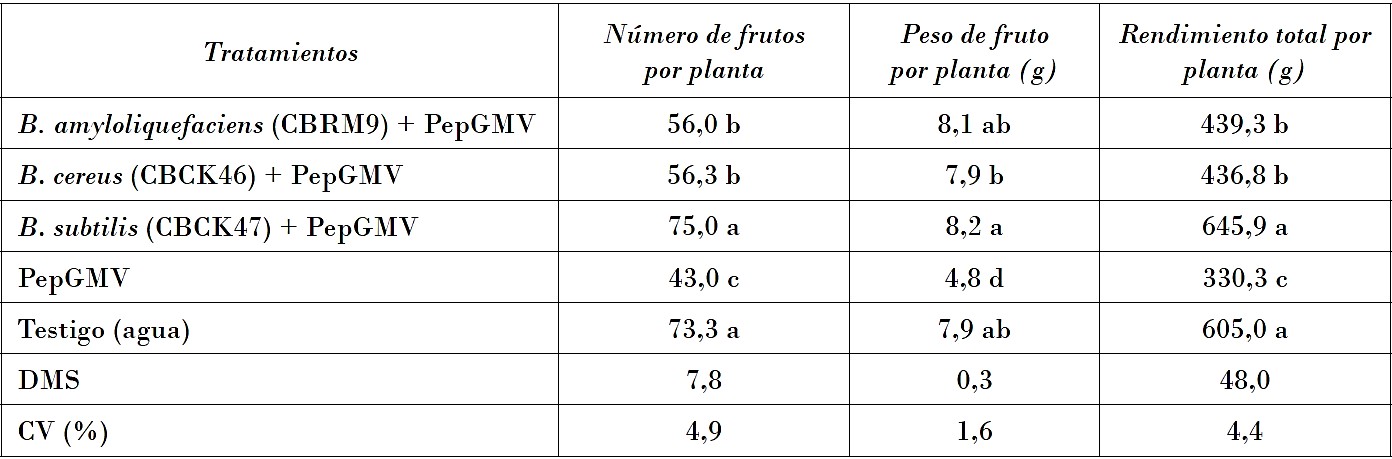
El empleo de especies de Bacillus como inductor de la resistencia sistémica en hortalizas contra fitopatógeno ha mostrado su efectividad al reducir la expresión de síntomas y mantener su rendimiento. En este estudio se evaluó en condiciones de invernadero el efecto de la inoculación de semillas y la aplicación al suelo de cepas nativas Bacillus amyloliquefaciens, B. cereus y B. subtilis en plantas de chile habanero (Capsicum chinense Jacq.), infectadas con el Pepper Golden Mosaic Virus (PepGMV) por el método de biobalística y mantenidas en macetas bajo condiciones protegidas. La inoculación de la cepa de B. subtilis redujo la expresión de síntomas (severidad 1,3) y el título viral del PepGMV (1,004 de acumulación del DNA viral); mejoró la capacidad fotosintética y el intercambio gaseoso en las plantas tuvieron un rendimiento de 600 g • planta-1 y un peso promedio de fruto de 7,9 g. En las variables agronómicas: biomasa seca total, altura, diámetro del tallo y volumen de la raíz no manifestaron diferencias estadísticas entre los tratamientos. Los resultados de este estudio proporcionan evidencia sobre la inducción de resistencia sistémica por la inoculación de B. subtilis en plantas de C. chinense contra PepGMV.
Detalles del artículo

Esta obra está bajo una licencia internacional Creative Commons Atribución-NoComercial 4.0.
Aquellos autores/as que tengan publicaciones con esta revista, aceptan los términos siguientes de la Licencia CC Reconocimiento-NoComercial 4.0 Internacional (CC BY-NC 4.0):
Usted es libre de:
- Compartir — copiar y redistribuir el material en cualquier medio o formato
- Adaptar — remezclar, transformar y crear a partir del material
El licenciador no puede revocar estas libertades mientras cumpla con los términos de la licencia.
Bajo las condiciones siguientes:
- Reconocimiento — Debe reconocer adecuadamente la autoría, proporcionar un enlace a la licencia e indicar si se han realizado cambios. Puede hacerlo de cualquier manera razonable, pero no de una manera que sugiera que tiene el apoyo del licenciador o lo recibe por el uso que hace.
- NoComercial — No puede utilizar el material para una finalidad comercial.
- No hay restricciones adicionales — No puede aplicar términos legales o medidas tecnológicas que legalmente restrinjan realizar aquello que la licencia permite.
La revista no se responsabiliza con las opiniones y conceptos emitidos en los trabajos, son de exclusiva responsabilidad de los autores. El Editor, con la asistencia del Comité de Editorial, se reserva el derecho de sugerir o solicitar modificaciones aconsejables o necesarias. Son aceptados para publicar trabajos científico originales, resultados de investigaciones de interés que no hayan sido publicados ni enviados a otra revista para ese mismo fin.
La mención de marcas comerciales de equipos, instrumentos o materiales específicos obedece a propósitos de identificación, no existiendo ningún compromiso promocional con relación a los mismos, ni por los autores ni por el editor.
Cómo citar
Referencias
Carrillo J., Lozoya E., Rivera. R. F., 2007. Symptom Remission and Specific Resistance of Pepper Plants After Infection by Pepper Golden Mosaic Virus. Phytopathology. 97, 51-59.
Choi H. K., Song G. C., Yi H. S., Ryu C. M., 2014. Field evaluation of the bacterial volatile derivative 3-pentanol in priming for induced resistance in pepper. Journal of Chemical Ecology. 40, 882-892.
Choudhary D.K., Johri B. N., 2009. Interactions of Bacillus spp. and plants – With special reference to induced systemic resistance (ISR). Microbiological Research. 164, 493-513.
García M. A., Trejo D. L., Rivera R. F., 2010. Veinte años de investiga- ción con Geminivirus en vegetales en Guanajuato. Acta Universitaria. 20, 84-92.
García G. L., Zeriouh H., Romero D., Cubero J., de Vicente A., Pérez G. A., 2013. The antagonistic strain Bacillus subtilis UMAF6639 also confers protection to melon plants against cucurbit powdery mildew by activation of jasmonate and salicylic acid-dependent defense responses. Microbial Biotechnology. 6, 264-74.
Holguín R. J., Vázquez R., Rivera R. F., 2004. Pepper Golden Mosaic Virus Affecting Tomato crops in the Baja California Peninsula, México. Plant Disease. 88, 221-221.
Kloepper J. W., Ryu C. M., Zhang S., 2004. Induced systemic resistance and promotion of plant growth by Bacillus spp. Phytopathology. 94,1 259-1266.
Kumar S., Agarwal M., Dheeman S., Maheshwari D. K., 2015. Exploitation of Phytohormone-Producing PGPR in Development of Multispecies Bioinoculant Formulation. In: Maheshwari DK, editor. Bacterial me- tabolites in sustainable agroecosystem, sustainable development and biodiversity. Switzerlan, Suiza: Springer, 297-317.
Liu X. M., Zhang H., 2010. The effects of bacterial volatile emissions on plant abiotic stress tolerance. Frontiers in Plant Science. 6, 1-6.
Luna M. L., Martínez P. R. A., Hernández I. M., Arvizu M. S. M., Pacheco A. J. R., 2013. Caracterización de rizobacterias aisladas de tomate y su efecto en el crecimiento de tomate y pimiento. Revista Fitotecnia Mexicana. 36, 63-69.
Morales F. J., 2011. Interaction between Bemisia tabaci, Begomoviruses, and plant species in Latin America and the Caribbean. In: Thompson, W. (ed). The Whitefly, Bemisia tabaci (Homoptera: Aleyrodidae) Interaction with Geminivirus-Infected Host Plants. Ámsterdam, Ne- therlands: Springer, 15-49.
Ruiz E., Mejía M. A., Cristóbal J., Valencia A., Reyes A., 2014. Actividad antagónica de filtrados de Bacillus subtilis contra Colletotrichum gloeosporioides (Penz.). Revista Mexicana de Ciencias Agrícolas. 5,1325-1332.
Song G. C., Choi H. K., Ryu C. M., 2013. The folate precursor paraaminobenzoic acid elicits induced resistance against Cu- cumber Mosaic Virus and Xanthomonas axonopodis. Annals of Botany. 111, 925-934.
Soria M. J., Trejo J. A., Tun J. M., Terán R., 2002. Paquete tecnológico para la producción de chile habanero (Capsicum chinense Jacq.). Conkal, Yucatán, México: SEP. DGTA. ITA-2. 75 p.
Torres I., Garzón J. A., Brown J. K., Becerra A., Rivera R. F., 1996. Detection and distribution of Geminiviruses in Mexico and the Southern United States. Phytopathology. 86, 1186-1192.
Vallad G. E., Goodman R. M., 2004. Systemic acquired resistance and induced systemic resistance in conventional agriculture. Crop Science.
, 1920-1934.
Van Loom C., 2007. Plant responses to plant growth-promoting rhizo- bacteria. European Journal Plant Pathology. 119, 243-254.
Wang S., Wu H., Qiao J., Ma L., Liu J., Xia Y., Gao X., 2009. Molecular mechanism of plant growth promotion and induced systemic resistance to Tobacco Mosaic Virus by Bacillus spp. Journal of Microbiology and Biotechnology. 9, 1250-1258.
Wang S., Wu H., Zhan J., Xia Y., 2011. The role of synergistic action and molecular mechanism in the effect of genetically engineered strain Bacillus subtilis OKBHF in enhancing tomato growth and Cucumber mosaic virus resistance. Bio Control. 56, 113-121.